
You’ve likely arrived here because something resonated — and you want to know who’s behind it.
What follows is both an introduction to how I work and an honest attempt to help you sense whether there’s a fit.
The best partnerships begin with that kind of clarity.
You might recognize yourself here.
The leaders I work with are not struggling because they lack commitment, intelligence, or institutional knowledge. They’re struggling because the conditions that would allow those qualities to translate into real results — trust, alignment, adaptive capacity — haven’t yet been cultivated.
Some arrive post-campaign or post-plan, sensing that the momentum they expected didn’t materialize. Some are navigating a significant inflection point — a leadership transition, a strategic pivot, a board that needs to step up. Some have done the conventional work and are ready, finally, for something that goes deeper.
You carry a genuine sense of mission and feel the gap between your commitment and your impact.
You lead a team or organization navigating real complexity — where the challenges don’t yield to more effort or better plans alone.
You value reflection as much as execution, because you’ve seen enough to know that sustainable change begins with insight meeting courageous action.
You’re willing to start with yourself — not because you have the most to fix, but because you understand that the leader’s inner condition is where organizational change either begins or stalls.
You’re ready not just to learn new practices, but to inhabit a new way of seeing.
My clients come from across the social sector — healthcare, higher education, human services, arts and culture, foundations, faith-based organizations, and mission-driven companies.
What they share is more important than their sector: they are experienced, values-aligned, and ready for a different kind of work.
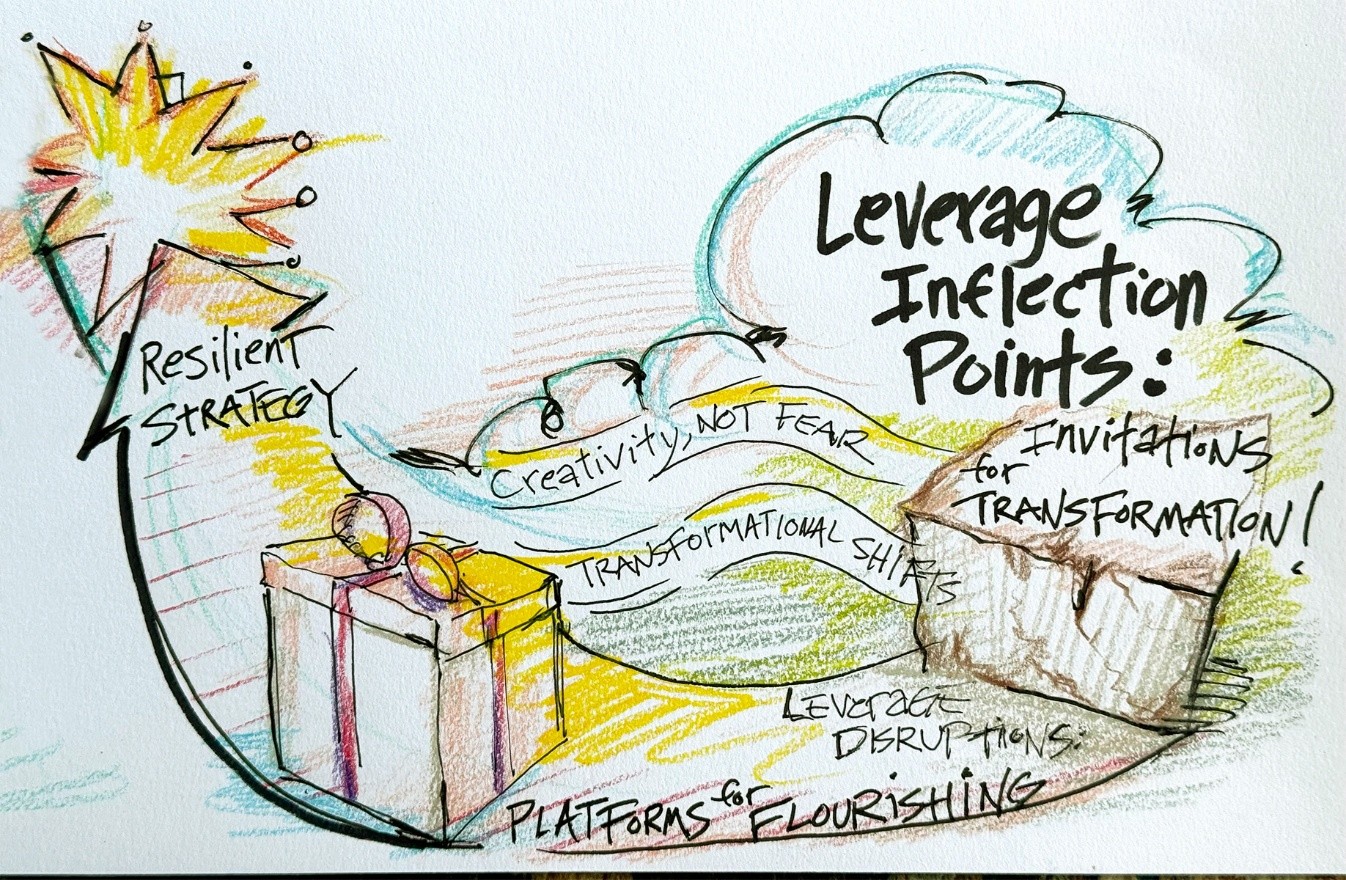
What brings most people to this conversation.
Uncertainty about the best way forward — not for lack of options, but because the usual frameworks aren’t quite fitting the situation.
A sense of misalignment — between strategy and culture, between what the plan says and what people are actually doing.
The awareness that traditional methods have stopped producing traction, and that something below the surface needs to shift.
The weight of carrying more than a leader should have to carry alone.
These aren’t signs of failure. They’re signs of a leader who is paying attention.
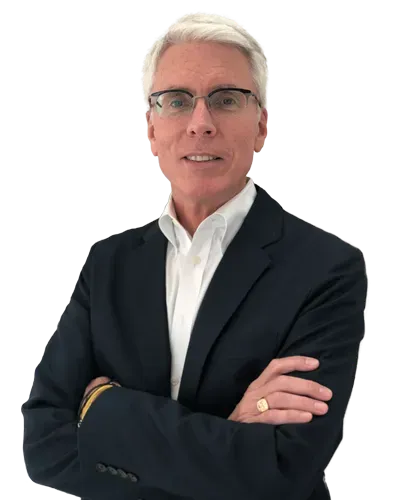
A bit about me.
I’ve been doing this work for forty years — sitting with mission-driven leaders at moments of real consequence, helping them cultivate what I call the invisible architecture of organizational change. Not the plan uploaded to the website. The conditions that make the plan live.
My approach draws on appreciative inquiry, whole-systems thinking, positive organizational development, scenario planning, and the Three Horizons framework — synthesized into a coherent methodology I’ve tested in the messy reality of actual leadership, in organizations of every shape and size.
I’ve worked with hospital CEOs and university presidents, foundation directors and executive directors, boards navigating succession and teams navigating change. I am certified by the Weatherhead School of Management at Case Western Reserve — the home of appreciative inquiry.
I’m a solopreneur. That means when you work with me, you work with me — not a team of associates who may or may not share my orientation or my values.
I bring to every engagement what colleagues have called ‘playful gravitas’: serious organizational change delivered with warmth, curiosity, and genuine partnership.
Now, the embarrassingly personal stuff:
My nickname at Orangetheory Fitness is SplatMan. Yeah, that begs for more details. We’ll have to talk.
I can bust out a spontaneous wicked cool air guitar solo. Unrelatedly, I’m a pretty good listener.
I don’t take myself too seriously. I take your work seriously.
What I believe.
The soft stuff is the hard stuff. You cannot toolkit your way to transformation.
What lives below the waterline — the beliefs, the assumptions, the conversational patterns, the unspoken commitments — is what actually determines what an organization produces.
My work begins there.
Not with the presenting problem, but with the conditions that are generating it…and blocking the root conditions of your high-point strengths becoming routine.
Not with the strategic plan, but with whether the people inside the organization have genuinely co-created the direction it names.
"Flourishing is cultivated, not controlled. What a leader sees, others believe. Organizations move in the direction of their dominant imagery."
This is not idealism. It is a practical orientation grounded in forty years of evidence.
When the invisible architecture shifts, what shows up above the surface shifts with it — in the culture, in the strategy, in the relationships with the people whose investment you need.
What shifts when this work takes hold.
Clear direction your team believes in
— not handed down, but co-created.
Unified culture and unified strategy
— moving in the same direction at last.
Energized, distributed ownership
— people bringing their full intelligence to shared challenges because they helped create the strategies that become the solutions.
Momentum that draws people in
— donors, funders, and partners who can feel the difference from the outside.
Don’t take my word for it.
“Our time together was truly a transformative experience, and I’m re-energized to journey forth with greater clarity and new intentions. My deepest gratitude for your gracious guidance and generous spirit.”
Dr. Amy Batiste
Founder and Principal Consultant, The Creative Catalysts, Inc.
“What I set out to do I couldn’t do alone. The Hubbell team cared deeply about what I was trying to achieve. When you’ve got someone that’s interested in, supportive of, and caring about what you’re doing — it’s a very happy experience.”
Pearl Veenema
CEO, Hamilton Health Sciences Foundation
“Because of new clarity, I have been able to make difficult decisions more quickly, navigate the most important decision our Board might ever make, and delegate more — and better — than I ever have. And we are raising funds at a higher rate than ever before.”
Dr. Don Christian
President, Concordia University Texas
If something in this resonates —
The best next step is a conversation.
A real exploration of what you’re working on, what you most want to accomplish, and whether there’s a fit.
You’ll leave with something useful regardless of what we decide.


